Welcome to my newly revamped blog! My humble little blog has been getting a little bit of attention, and folks are stopping by from all over the world, I thought it was time to spruce up the place a bit for company. The look and title are different (a little less defensive, perhaps?) but the meat and potatoes of politics and world affairs hasn't changed. I'll still be dishing it out every morning (after having already dished out breakfast, thereby trapping my 2-year-old in his high chair-- you know, I've gotten used to working with children's TV in the background!) so stop by anytime.
Really, people, start leaving some comments! I know you're there! I'd love to hear some other opinions, or requests for post topics.
In the meantime, try to stay cool in these dog days of summer and blessed be!
PS-- We're moving to a new house around mid-August, so the blog posts might slow to a trickle right around then...
PPS-- HUGE CONGRATS to Floyd Landis, who won this year's Tour De France!!! He'll be having hip surgery soon, here's wishing him all the best. The Tour has not seen the end of Living Strong!
Tuesday, July 25, 2006
Seeds of Ideas Takes Root, Blooms

Friday, July 21, 2006
All Hell is Breaking Loose, Part II.
Previously on "All Hell Is Breaking Loose":
Muslims are divided into Sunni and Shi'a, which is similar to the differences between Catholics and Protestants in Christianity. They generally don't like each other and think that the other side is worshipping all wrong.
Muslims are spread all over the world, but some countries are dominate in one or the other sect of Islam. Needless to say, countries that identify with one side are going to back up that side. To compare this to the familiar, Protestant countries like England and Catholic countries like Spain might feel the need to take sides in a Catholic/Protestant conflict. Catholic countries like Mexico, while an ocean away, might feel a camaraderie with their Catholic brethren in Ireland even though culturally they have little in common.
So, who's who? Well, as Wikipedia points out, the Shi'a are kind of the proverbial "red-headed stepchild" of Islam. "One of the lingering problems... in estimating the Shi'a population is that unless the Shi`a form a significant minority in a Muslim country, the entire population is often listed as Sunni... No Sunni-Shi'a breakdown is available for many countries... This is certain to have exaggerated the proportion of Sunni Muslims." It's like the way the US is considered a Protestant country even though there are a lot of Catholics here, certainly enough to make a political impact, as we saw in the recent immigration debate.
Another great example is Iraq. Under Saddam, the country was considered to be Sunni because Saddam and his government were Sunni (though it seems they had lapsed into secularism). As we found out when we cracked Iraq open, it turns out that most of the actual people inside were Shi'a.
Wikipedia is saying that the conventional wisdom breaks it down 85% Sunni and 15% Shi'a, even though because of the problems listed above, that's probably not right.
What's happening in the world is the rift between these two sects is growing and becoming more violent. It seems that when this really ignites, nation-states are going to take sides. So, who sides with whom?
Out of the major players on the world's stage who are predominately Muslim, it breaks down (as far as I can tell, with Wikipedia's help--they have an awesome chart-- and accepting the above disclaimer) like this:
SUNNI
Somalia
Saudi Arabia
Turkey
Yemen
Kuwait
Afghanistan
Libya
Pakistan
United Arab Emirates
Egypt
Jordan
Syria
Indonesia
SHI'A
Bahrain
Iran
Iraq
Out of the countries that aren't predominately Muslim, but have significant (60-75%) Muslim populations, their Muslims break down like this:
SUNNI
Sudan
Albania
Bosnia Herzegovenia
SHI'A
Lebanon
If you're wondering about G8 countries like the US, all of their Muslims are listed as Sunni, probably because of the poor data collection mentioned earlier. (While Muslims might list their religion on US census forms, for example, I don't think it specifies "Sunni" or "Shi'a".)
So let's take a headline from the other day: "Saudi Arabia, Jordan, and Egypt issue a statement condemning Hezbollah's attack on Israel." While that seems significant, Arabs turning on Arabs instead of banding together in lockstep against Israel, look at the chart. Hezbollah is a Shi'a group from Shi'a Lebanon. Saudi Arabia, Jordan, and Egypt are all Sunni. Iran supports Hezbollah, and from a glance at the chart, that makes perfect sense. The Sunni Syrians, on the other hand, took over Shi'ite Lebanon until they were recently kicked out, which explains the animosity there. On the other hand, the Syrians aided Hezbollah in the past, because Hezbollah was formed to fight the Israelis, which despite their differences is something radicals of both groups can get behind. In fact, in this growing rift between Sunnis and Shi'a, the Israel/Hezbollah conflict may be the only thing keeping them together, as seen by the Syrians welcoming Shi'ite Lebanese refugees with open arms.
Iraq has become the hotbed of the conflict between the Sunni and the Shi'a. The Sunni dictatorship of Saddam allowed for Sunni abuse of the Shi'ite majority. (Well, let's face it, the Husseins were just downright sick puppies, and they happened to be Sunni and used that as an excuse.) The US came in and, through many missteps but I think with the idea of rooting for the underdog, ended up handing the country back to the Shi'a. Needless to say, after years of horror, the Shi'a are back and they're pissed, as the saying goes. That's why what is flippantly referred to in the MSM as "sectarian violence" has replaced any kind of insurgency in Iraq.
"I can't understand/ what makes a man/ hate another man," Depeche Mode once sang, and it is unfathomable why such a horror would occur unless you're a part of it. I still find it hard to believe that Ireland was torn apart by what we would now call "sectarian violence", when really, who cares who's Catholic or Protestant. But go into a pub in Ireland and ask that question, and you'll get an earful-- or, the patrons will narrow their eyes at you as if to say, "Idiot," and turn back to their Guinness without a word.
The Shi'a are back in Iraq with a vengeance, and are flooding into the police forces and military, from which position they are purportedly abusing and murdering Sunnis. Those that don't get jobs join gangs, which they euphamisitcally call "militias", and go around abusing and murdering Sunnis on their own. What a fun place.
Is it any wonder that the Sunnis in other countries are starting to get angry with the US for backing the Shi'a and putting them in power? And who exactly would be mad at us? Saudi Arabia, Jordan, Egypt, Syria, Afghanistan, and Turkey, for starters. At least four of those are our business partners and in recent years, friends of a sort, which would be a great loss to us if they should turn on us. Iran, for all of its saber-rattling and hatred of the US, is actually not doing as much as you might imagine to provoke us because on this greater sectarian battleground, we just helped them by creating another Shi'a country. (That's why people keep saying, "The big winner here is Iran," which doesn't really make any sense unless you understand the Shi'a/Sunni conflict.)
I don't have a profound point here, just wanted to get this all straight in my own head and hopefully help you out too. I do have a warning: keep an eye on these Sunni and Shi'a divisions, they will be key to understanding wide-spread conflict and (any God willing) resolution.
UPDATE:
Wow, talk about topicality: just took a look at Salon.com's political blog by Tim Grieve, who posted this:
The Bush administration has long insisted that news stories about violence in Iraq obscure the progress that is being made on the political front.
Perhaps it's time to put that story to rest.
In an extraordinarily gloomy report from Baghdad, Reuters correspondent Mariam Karouny says that Iraqi leaders have "all but given up on holding the country together." Among the ideas now on the table: Divide Baghdad into two zones, one for Shiites and one for Sunnis, in the hopes of stopping the bloodshed between the two.
The harsh words from one unnamed government official: "Iraq as a political project is finished."
I certainly hope that's not the case, since division is never the solution ("Mr. Gorbachev, tear down this wall!" Reagan) but I will say I understand all that a lot better having done all this research.
All Hell is Breaking Loose
There is something really important happening in the world. It's not just that Hezbollah and Israel are at each other's throats, it's not just that the US has destabilized the region and upped the ante. It's that there are two main branches of Islam, the Sunni and the Shi'a, and they are ready to fight to the death.
All of your preconceptions about the conflict in the Muslim world, which states are nice and/or democratic versus which states are mean and/or "rogue", forget them. This battle is going to come down based on who believes what.
If you're having trouble getting your brain around this, think about the Catholics and the Protestants. While both religions follow Jesus Christ, they differ significantly about how to follow Him. To over-simplify it (oh, don't worry, I'll be over-simplifying the Muslims too), the Catholics believe that Jesus chose the disciple Peter as his successor, and Peter formed the Church and became the first Bishop of Rome, a position which later became known as the Pope. That makes the Pope the direct "descendant" of Peter, who got his marching orders directly from Jesus, which makes him the Supreme Head of the Church. Conversely, the Protestants think that Jesus didn't pick a clear successor (there were other Bishops of other cities at that time who were not considered any more important than Peter) because His whole point was that your relationship with God is personal and you don't need anyone in between you and God. This is known as the "priesthood of the believer", which means that if you believe, you are a priest yourself, and you don't need any intercession of priest or even prayers to saints.
Well, that sounds like a pretty academic argument, but if you know anything about European history, you know it has been the cause of much strife and death. And the beautiful, ethereal Ireland became the main front in a war of ideas in modern history. The Irish have more in common with each other than with any other people on the planet, and yet they were killing each other during the Troubles as if Catholics Were From Mars and Protestants Were From Venus.
The Sunni/Shi'a division is very similar. Muhammed (Peace Be Upon Him) also did not leave a clear successor, which left his followers at a bit of a loss as to how to proceed after his death in 632.
Mohammed was a merchant who often went to caves near Mecca to pray. "Muslims believe that in 610, at about the age of forty, while in a cave in the mountain called Hira, he was visited by the Angel Gabriel, who commanded him to recite the verses sent by God. These verses were later collected as part of the Qur'an (which was revealed to him over a period of about twenty-three years until his death)." [Wikipedia]
He went on a preaching mission, similar to Jesus, reinforcing monotheism and warning of Judgement Day, similar to John the Baptist. "He did not completely reject Judaism and Christianity, two other monotheistic faiths known to the Arabs, but said that he had been sent by God in order to complete and perfect those teachings." [Wikipedia] Remember, ultimately the God of Judaism and the God of Christianity and the God of Islam are all the same entity, the religions having already branched off (twice) many centuries before.
He moved the people of his time to reinvigorate their relationship with God, and as the quote above said, to "perfect" it. Consequently, his death left a large vacuum. If Muhammad was the only one who understood what was to be done and how to perfect religion, then who would direct the people now? "Two questions faced these early Muslims: who was to succeed Muhammad, and what sort of authority he was to exercise." [Wikipedia] Jesus left a similar vacuum-- He told us that there was a better way, but He was gone after three years, leaving mere mortals to figure out what the heck He was talking about.
What we would call the "disciples" of Muhammad are called "caliphs" in Islam. Mohammed had plenty of these. Traditionally, according to Wikipedia, Arabic leaders were chosen to lead by a committee called the "caliphate" (think of Jesus' disciples, only more of them). If a familial heir was competent, great, but if not, the caliphate was free to choose someone else that would do a better job. (Apparently there was no official method to do this.)
Muhammad had two potential successors--
-- Abu Bakr who was M's lieutenant and right-hand man (think St. Peter) and
-- Alī ibn Abī Talib, who was his son-in-law.
The followers of Abu, the lieutenant, became the Sunni.
The followers of Ali, the son-in-law, became the Shi'a.
(I hope it's not rude to shorten their names like that, but it will help readers follow all of this.)
The Sunni refer to themselves as followers of the "sunna" or the TEACHINGS of Mohammed. Their leaders are called Caliphs.
The Shi'a refer to themselves as followers of the "Ahlul Bayt", or the FAMILY of Mohammed. Their leaders are called Imams.
They not only don't agree, but these days they really don't get along at all, ala the Catholics and the Protestants in Ireland.
In Part II, we'll look at what effect this split is having on today's politics.
Saturday, July 15, 2006
Torn
A news junkie who is a caring citizen, like myself, often finds she is torn when waking up in the morning: Do I turn on the TV and see how bad it is today, or not?
It seems we might be on the brink of WWIII. I'm not sure what else to say about that.
It's strange to watch a war on TV that we're not in. I'm so used to the Pentagon briefings about planned strikes that it's very strange to watch the reporters scurry around and report where bombs fell and being genuinely surprised by each turn of the screw.
Stranger still to watch them cover anything else. I was flipping around last night and after wrapping up a panel discussion on this crisis, the cable news TV host (not trying to protect an identity, just can't remember!) went on to tease for the next story, which was that somebody saw TomKat's baby and said it was "funny-looking", which besides being COMPLETELY AND ENTIRELY IRRELEVANT was also three-day-old news.
I haven't turned on the TV yet but in pulling up my browser I saw a bit of CNN.com.
Now, I must be wrong about this, but I thought the idea was to keep Syria in particular out of this conflict. It may well be, as many assert, that the nation of Syria (meaning, its government) is one of the two "parents" of Hezbollah-- Iran being its "father" I guess. So perhaps that's what you do when the kid starts acting out and, you know, bombing the neighbor's cat: you call his parents. But it was also my impression that Syria was saying if they had to get involved, Israeli would pay big time-- they're already pissed off after the recent fly-by of the Israeli air force over the Syrian President's house-- and we know that Israel would be ready for them.
I must have been wrong about all that though, because the headline on CNN.com was "Bush calls on Syria to act". Now, he's an idiot but surely not that big of an idiot, right? He'd never say "Bring it on"-- oh, wait.
Leaving aside that argument-- is he calling Hezbollah's mom, or inciting a bigger conflict-- I opened the article to see what it had to say, and this line caught my eye:
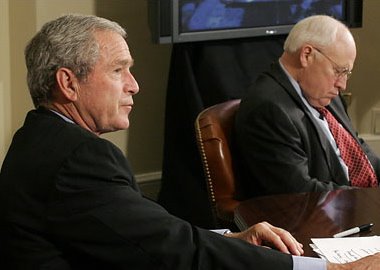
"The best way to stop violence is to understand why the violence occurred in the first place," Bush said during a news conference ahead of the Group of Eight summit in St. Petersburg, Russia. [CNN.com]
As Yosemite Sam would have said, "Oooooh, that varmit!" OK, here's why that pisses me off. (And wait until you hear the rest of it.)
After 9/11, the question on everyone's lips was "Why do they hate us?" Even Oprah did a show on it, bringing on the then-not-questionable Judith Miller to explain it. We were so surprised that the US could have done anything or be doing anything to make people want to inflict that kind of violence on us. Our first reaction was to find out why.
Of course, finding out why might have led to finger-pointing and/or a reassessment of US foreign policy, which was not the direction that the White House wanted to go right after 9/11. If there was a "post-9/11 mindset", then there is also a "post-Operation Iraqi Freedom mindset" where now we look at things a little more cautiously and analytically. But we were still in post-9/11 shock, and while thoughtful consideration might be the knee-jerk reaction for some of us, it wasn't for Karl Rove.
So before the conversation really got started, the White House shut it down by hitting us where it hurt-- accusing us of being pussies for wanting to talk about it.
The quote I was hunting for, to my surprise, was only from June 2005, to which fact I can only say, this is how he felt all along, and finally said it. And that he shifted the conversation using other political means, like putting up the Patriot Act for a vote which worked on the premise that there was nothing else to do but attack, attack, attack.
Regardless, here it is:
"Conservatives saw the savagery of 9/11 in the attacks and prepared for war; liberals saw the savagery of the 9/11 attacks and wanted to prepare indictments and offer therapy and understanding for our attackers," Rove said. [Washingtonpost.com]
Now, let me reprint that Bush remark so you can see them side-by-side:
"The best way to stop violence is to understand why the violence occurred in the first place," Bush said. [CNN.com]
Oooh, that varmit!
Again, I'm torn! Does one get mad at them for being hypocrites, or happy that they've come around? Arianna Huffington recently found herself in a similar debate. (Sorry, can't find a link right now and I'm making pancakes so I just need to keep going.)
But even more mind-snapping than that was what he said next!
"And that is because Hezbollah has been launching rocket attacks out of Lebanon and into Israel because Hezbollah captured two Israeli soldiers." [CNN.com]
OK, WHAT? First of all, that sentence doesn't make any sense. Why would H attack I because H kidnapped I's soldiers? Now, Israel bombing Hezbollah because H stole their men I get, although it certainly leaves out more than half of the story. But this makes no sense at all.
Which might even be fine, except that he was just crowing about "understanding why violence occured" and he clearly doesn't understand much of anything, including what's happening on the ground right now.
The only thing worse than having Bush as Pres during and after 9/11, that is, our war, is having him President during someone else's war which is inextricably linked with ours.
So make some blueberry pancakes and watch the beginning of WWIII. Or a nice Sandler comedy like "50 First Dates". (Say whatever you want about me, but that movie is adorable.) Or if you're one of those studious types that feel the need to make good use of your time at all times, go shopping for a hybrid car. Word has it that gas is going to hit $4/gal, and if Iran gets into this, much, much higher.