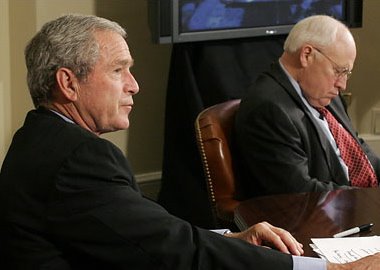
And in fine form. He's testifying in front of the House hearing on Pat Tillman's death, and he answered Rep. Elijah Cummings' question (something like what the hell happened) was, (paraphrasing), "Well, you know, there are lots of investigations all the time, I mean, heck, how could everyone know everything?"
Someday when I grow up to be a real blogger I'll figure out how to get exact quotes while listening to CSPAN 3 on the net. In the meantime, here's where all the excitement is happening...
Showing posts with label US military/troops. Show all posts
Showing posts with label US military/troops. Show all posts
Wednesday, August 01, 2007
Rummy's back!

Tuesday, July 10, 2007
Just when you thought it couldn't get more ridiculous: Enter the Post-Surge
Or, If You Liked The Surge, You're Going to Looooove This!
From CNN.com:
Six months after announcing an increase of nearly 30,000 U.S. troops that became known as the "surge," Bush is scheduled to appear at a town meeting in Cleveland, Ohio, on Tuesday where he's expected to push for a "post-surge" phase of the four-year war, senior officials told CNN.
However, senior administration officials said that the Bush administration does not plan to make any major changes in its war strategy despite increased calls from Republican lawmakers to begin a drawdown of U.S. troops in Iraq.
...The report will show "some of the benchmarks have been made, some of them haven't" and will set off a debate that will result in "the beginning of a new way," White House spokesman Tony Snow told CNN's "American Morning" on Tuesday.
"What Congress will get this week is a snapshot of the beginning of the retooling of the mission in Iraq," Snow said. "Everyone says, 'We want to do it a different way.' We agree. It's just now started."
Oh, goodie. Because what we really need is
a snapshot (=generated image of a brief moment of the past which may or may not accurately represent the event)
of the beginning (=don't expect to see this yet)
of the retooling (=to redesign the machinery that will allow for improvements to happen in the future)
of the mission (=maintaining a holding pattern while the US crams an immoral oil law down the throats of Iraqis which will cost them billions in infrastructure while the four top oil companies will retain the lion's share of the revenue)
And worse, all that has "just now started"! Gasp!
I'm starting to think impeachment is too good for these people. Do they still do that thing with the ant hills and honey?I met a wonderful young man who hopes (!) to be heading back oversees very soon. He's hoping because he's made the jump from grunt to Military Intelligence, and he's very excited about it, as any young man would be at his career taking a leap forward. When we talked, I asked him my two main questions (you're going to have to take my word for all this, now that he's in MI he really didn't want me revealing his name):
1. When you come back here and see us all being oblivious and shopping and watching American Idol, do you just think we're idiots? (I asked because I can only imagine coming back from a war zone and then listening to someone bitch about their iPhone must make you want to punch them.)
"No, because we all have our jobs, and that's how it should be. Mine is over there, yours is over here."
2. When you hear that there is discussion back here about the purpose of these wars and everything, does that hurt your morale?
"For me, no. But in general? Of course it does, yes. But everything hurts morale. Not having a shower in the morning hurts morale. So yes, hearing people (especially the ones who don't know what they're talking about) bitch about the war hurts morale. But everything does, so you just get used to that until it doesn't matter anymore."
My answer to this will be familiar to Constant Readers: Our big, shiny military is like a big, shiny gun. It's our job as civilians to take care of this gun, maintain it, treat it with care, and for God's sake be careful where you point that thing. We don't point it at ourselves (Posse Comitatus), we don't point it at our friends (treaties). As they say here in Texas, "Don't pull a gun unless you intend to use it, and don't use it unless you intend to kill with it." (A sentiment I don't quite follow, not being a gun person myself, but I'm sure folks around here would school me.)
I believe in the debate because I love our troops. If we don't debate, it's like shooting off the gun with a blindfold on. If we don't debate, and make sure we are doing the right thing, we are irresponsible. We are irresponsible to them, to that boy who is so excited to go back. We must take care of him, which not only means his equipment while he's there and his mind and body when he returns, but it means that we must be very, very careful where we send him and what mission we give him so that we do not waste our big shiny guns and our eye-candy boys (oops, sorry, I mean professional soldiers, but c'mon, he's dreamy!) on stupid conflicts handled poorly.

I can't confirm or deny that this exquisite specimen of Texan manhood is a member of the US Military.
Tuesday, May 09, 2006
Support Our Troops... Bring Them Home
This post is long overdue, and consequently I might only be pointing out the obvious. It's been obvious to me all along, so it's hard to tell.
I was born in 1969, so I'm not an expert in Vietnam War-era politics. But as I understand it...
There was a radical revolution underway in the mid-60s to mid-70s, in which all the previous social mores were being challenged. For every point of conventional wisdom, there was someone standing up and saying, "Why? Says who?" This made a huge mess in some areas, while changing the world for the better in others. I can't fault anyone who was looking at something in a new way, not only because I respect such questioning, but also because once one starts questioning one thing, it's hard to stop. Why should one thing be set in stone when other stones are being overturned? How does one know which stones are right and which need turning until you turn them?
In this environment, there were many, many movements trying to reconceive preconceptions and work towards their own agendas. One person might identify with several movements-- that is, "I'm against segregation, for women's rights, and against the war,"-- but that is not to say that all radical movements identified with each other, or that any radical person shared all the radical beliefs. One might be a feminist for the war, or an integrationist who doesn't like "treehuggers". But it is very easy, in 40 years of hindsight, to look back and lump them all together. Many people even see a hippie on the street today and assume that they know all of his/her politics. But that is a misconception.
And in this Vietnam War-era, there was a "perfect storm" that led to soldiers coming home from the war and being spit on.
1. The peace movement (or, to avoid generalization, some parts of the peace movement) was saying that war and killing is always wrong. After 30 years of wars, this was radical-- and like many radical statements, people tried to paint it with a broad brush. It might be true that war is bad and killing is wrong, but I think we know today that sometimes it's justified and sometimes it's not. Back then it was being perceived as much more black-and-white. And again, this makes sense to me. How are you reconceiving something if you are compromising with it? Sometimes the first new thoughts on a subject have to be wild and strident. Following that can be debate and consensus.
2. There was a draft. This meant that people were being called up to fight regardless of their feelings on the subject, rather than the volunteer army that we have today. Today people join the army the way others join the police force-- because of an honorable desire to protect and serve. In a draft, it's almost like kidnapping your children and making them fight.
And in this era of radical thinking, there were some who stood up and said, "Why?" Why should you allow yourself to be drafted just because "your parents" (i.e., the establishment) said so? Why not burn your draft card and run off to Canada? These people were really thinking outside the box, and again, I can't blame them. They were questioning so many other things, and some of those radical ideas were really panning out, why wouldn't they question this and come up with a radical solution?
But the flip side of this was that if you didn't burn your draft card, if you went ahead and showed up to be a soldier, then you were branded as someone who lacked the courage to stand up against The Man, someone who was colluding with the Murdering War Machine. And though now that things have calmed down over the course of 40 years, we can look back and say that leap of logic was faulty, I don't think it seemed that way at the time. At the time, it was "You could have been a radical, but you became a sheep. Shame on you!" And really, in the context of the day, I think that made a certain amount of sense to people, and I can't fault them for thinking that way. This is the "first straw", if you will, the first step that led to the spitting, this idea made famous so many years later by our President, "You're either with us or against us." So if you were a soldier, then you have thrown in with the Evil Ones who were pushing and manhandling the war, so you are just as much at fault as they are.
3. The war was a mess. It wasn't being fought properly or won. And so the voices of those who said, "Hang on a minute! Can we think about this?" joined those who were saying, "War is evil!" and as I mentioned before, the chorus began to sound like one voice, instead of the choir of many voices each with their own take on things.
4. There was a lot of weirdness going on in Viet Nam. I'm not trying to color all soldiers the same, but one of the problems with the draft was that it was taking everyone, including the less honorable, and those who were forced to go and didn't want to be there were "acting out" as we might say now. There were rapes, senseless killing of civilians, extensive drug use, etc. It was a broad and long war, and statistically I guess some things are bound to happen if the war is broad enough and long enough. And you'll notice we haven't had a draft since, so I think that the Pentagon saw what the cost could be if you take everyone. But this was another straw, the perception that soldiers back from Viet Nam were suspect in some way. Who knew what the vet sitting next to you on the bus was up to just a few months ago? And the public was one step closer to spitting.
5. There was no ticker-tape parade, probably because we got our asses handed to us, and who wants to throw a parade for that? The war ended with a whimper, the whimpering of our military limping home to lick their wounds. This is often touted as the fault of the Left, as if the Right wanted to throw a parade but the Left put its foot down and said, "No! No parades! We want to spit on them instead!" Again, hindsight is lumping together two separate things as one--"how we treated the troops when they came home"-- which might better be described as, "One side spat, the other didn't throw you a parade."
6. And on the subject of "with us or against us", the public was polarizing into those who were "radical" and those who were "establishment". So if you spoke out against the war you were labelled as a spitting-on-soldiers radical, even if you weren't one (maybe you just thought we weren't handling it right). So while the eventual "spitting" (that is to say, disgust with soldiers) was coalescing into a concept, so was the generalization of the Left, so that they were all treated as "spitters". I don't even know if there was that much spitting (proverbial or otherwise) going on. Perhaps that's a leftover perception painted by conservatives and cemented in the public mind during the Reagan years. It is certainly a polarizing idea-- "The Left" spitting on solidiers, who because of the draft were everywhere and everyone's children. I don't have anything to back this up, but "They are spitting on your children!" would be a brilliant slogan for conservatives of the day to scare people away from Democrats.
Perhaps there were other factors too that I'm not considering at the moment. But I hope that I have shown you how spitting on soldiers was really a product of its time, not necessarily a product of questioning war.
Wednesday, April 26, 2006
Rummy's Officer Trap
There has developed in the public discussion regarding the denouncement of Secretary Rumsfeld by retired officers a paradox that no one seems to address.
1. Retired officers are saying Rummy messed this up from start to finish (ok, that's a simplification).
2. The common criticism of these officers is one of two:
a. Why didn't you say something at the time? (i.e., it must not have bothered you then)
b. You're retired, what do you know? (i.e., you're not here now so you don't really know what's going on)
3. People from the military (whether they are experts familiar with military culture, the retired officers themeselves, and even current Joint Chiefs Chairman Peter Pace) explain that if you don't like an "order" (by which I mean the handling of a situation by anyone above you) your choice is to either suddenly get behind it and carry it out, or retire.
So you don't like Operation XYZ, and you try to tell your COs that, politely and saying, "With all due respect..." a lot, but in the end they are going with Operation XYZ. They tell you, "Either shut up and do it, or retire and say whatever you want." So because you have a high moral character and can't leak the news or lead your men into disaster, you retire. Then you stand up and publicly say what you believe, and the Pentagon responds, "Well, you weren't publicly complaining at the time, so you must have been fine with it, and besides, you're out of the loop now so what do you know?"
Does anyone else think that is patently unfair? Your bosses give you an option and then attack you for taking it?
Subscribe to:
Posts (Atom)